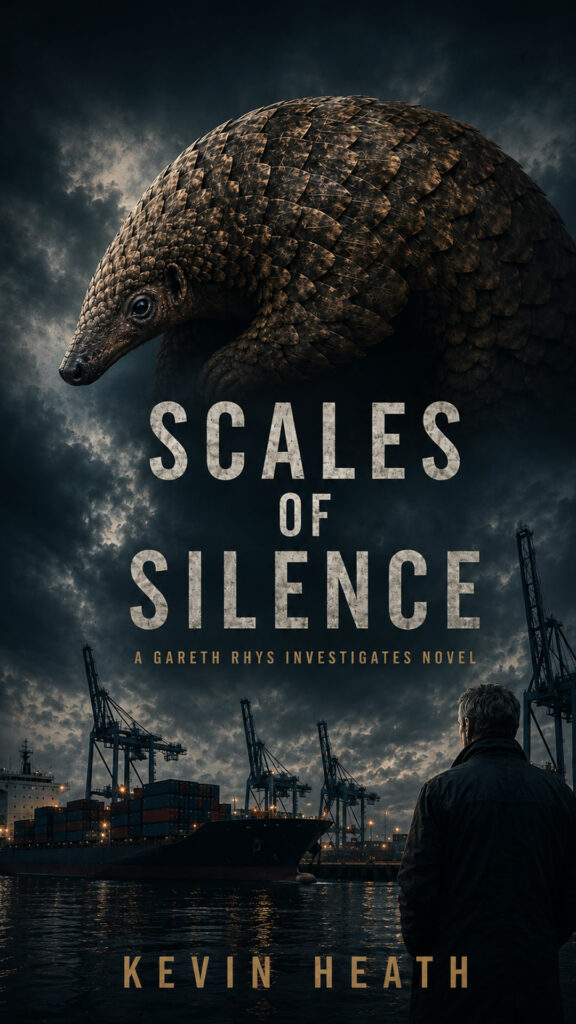

When a body is found on the banks of the River Usk, it looks like a tragic accident - until journalist Gareth Rhys notices something that doesn’t belong.
Clutched in the dead man’s hand is a pangolin scale.
Detective Sergeant Sara Llewellyn isn’t convinced by Gareth’s theories, but as another body turns up and whispers of illegal dog fighting and badger baiting begin to surface, the case quickly spirals beyond a simple investigation.
Following a trail that leads from the muddy fields of St Brides to the shadowy operations of Newport’s docks, Gareth and Sara uncover a hidden world of wildlife trafficking, violence, and power - where rare animals are worth more than gold, and the people behind the trade will kill to protect it.
But when the evidence doesn’t add up, and a frightened witness becomes the prime suspect, Gareth begins to question everything he thought he knew.
Was the first victim really part of the crime - or trying to expose it?
And in a town where everyone seems to know everyone, how far does the truth really reach?
As the investigation tightens, Gareth finds himself caught between justice and something far more dangerous: a network that thrives on silence - and has already started watching him.
In this gripping Welsh mystery, loyalty, corruption, and the cost of truth collide in a case where nothing is quite what it seems… and every answer comes at a price.
Chapter 1
The call came just after dawn, when the sky over Newport hung low and heavy, the colour of wet slate pressing down on the rooftops. Gareth Rhys was already awake. He often was.
Sleep, these days, came in fragments, thin, unreliable scraps that dissolved the moment his thoughts began to circle. It wasn’t quite insomnia. He could fall asleep easily enough. Staying there was the problem. Years of early starts, late nights, and the quiet, persistent weight of his work had rewired something in him. Rest never lasted. His mind refused to let it.
READ MOREThere had been a time when he could switch off. He remembered that clearly, though not recently. Back when cases ended cleanly, when stories had conclusions that felt like answers rather than compromises. Back before the things he’d seen began to linger. Now they stayed. Quiet. Patient. Waiting.
Beside him, Lowri stirred. She didn’t wake fully, just shifted beneath the duvet, her hand drifting instinctively across the mattress to the space he had vacated an hour earlier. Even in sleep, she knew when he was gone. Gareth stood in the doorway for a moment, watching her. The room was dim, washed in that grey pre-morning light that softened edges and blurred detail. Lowri’s face looked younger like that, the lines smoothed away, the worry less visible. For a moment, he allowed himself to see her as she had been years ago, before his work had begun to take more than it gave. Then he looked away.
He left the door half open and moved back down the narrow landing, careful to avoid the loose floorboard near the top of the stairs. It creaked if you stepped on it wrong. He had learned that the hard way. He kept the kitchen light low.
The house held that peculiar early-morning stillness, thick, suspended, as though sound itself had yet to fully arrive. Even the clock on the wall seemed quieter. The kettle boiled. Clicked off.
He poured the water into a chipped mug, the same one he’d owned longer than most of his professional contacts. The handle had been glued twice. It still leaked slightly if you tilted it the wrong way. He never replaced it. Some things, once they’d lasted long enough, earned the right to stay.
The laptop sat open on the table, its glow casting a pale, artificial light across his face. The article had been there for three days, untouched except for minor edits he kept undoing.
Illegal snaring in the valleys. Foxes, mostly. Occasionally dogs. Once, though he had never written about it, a child who had wandered off a footpath and into a wire loop hidden in the undergrowth. He could still see the boy’s face. The panic. The confusion. The way his small hands had pulled at the wire, tightening it further without understanding what he was doing. They’d got to him in time. Another few seconds, another twist, and it would have been his hand instead of the fox’s neck.
Gareth read the final line again.
The cruelty is rarely seen, but always present.
He frowned.
Too heavy. Too deliberate. It sounded like something written for effect rather than truth.
He hovered over the keyboard, fingers still, then deleted it. The truth didn’t need dressing up. Not like that.
He leaned back slightly, rubbing his eyes. The room felt colder than it should have. Or maybe that was just him. His phone buzzed against the table, the vibration loud in the quiet room. Unknown number. He watched it for a second. Then another. He let it ring once longer than necessary before picking it up.
“Rhys.”
There was a pause. Faint background noise. Movement. The soft rustle of clothing, the distant murmur of voices. Someone adjusting their grip on the phone. Then: “You’re the wildlife bloke, yeah?”
Gareth leaned back slightly in his chair, rubbing at the stubble along his jaw. Mid-fifties now, and the years had settled into him in quiet, unremarkable ways. Slower starts to the day. Joints that complained in the cold. A patience that had thinned into something sharper, less forgiving.
“Depends who’s asking.”
A breath on the other end. “Police. Gwent.” A pause. “We’ve got something… unusual.”
Gareth’s eyes flicked towards the bedroom door. Still quiet. Lowri hadn’t moved.
“What kind of unusual?” he asked, lowering his voice.
Paper shuffled on the other end. Someone nearby said something that didn’t quite carry. The caller hesitated. As though deciding how much to say. “Body down by the Usk,” they said at last. “There’s something in his hand. Someone reckoned you might recognise it.”
Gareth didn’t move. That wasn’t a normal call. Not even for him. “What kind of something?” he asked.
Another pause. Then: “Looks like a scale.”
Gareth closed his eyes briefly. The word sat wrong. Out of place before he’d even begun to think about it. His mind moved quickly, too quickly, through possibilities. Fish. Reptile. Something local. Something explainable. None of them settled.
“Send me the location,” he said. He ended the call without waiting for a response and remained where he was, the quiet pressing in around him, thicker now, heavier.
The house no longer felt still. It felt expectant. Then he stood. He pushed the bedroom door open a little further this time. Lowri was awake. Propped on one elbow, watching him.
Her hair was loose around her shoulders, her expression somewhere between concern and resignation, like someone who had been here before and knew how it usually ended. “You’re going out,” she said. Not a question.
Gareth nodded, pulling a shirt from the back of a chair. “Call from the police.”
That shifted something in her face. Not alarm. Recognition. “Serious?”
“Don’t know yet.”
She gave a small, almost disbelieving exhale. “You never know yet,” she said. “That’s always how it starts.”
Gareth didn’t respond immediately. He pulled the shirt on, buttoning it without looking.
Lowri watched him. “You could say no,” she said.
He paused. Just for a moment. Then continued. “I could.”
“But you won’t.”
“No.”
She pushed herself upright, the duvet slipping slightly as the cold air crept in. “What is it this time?”
“Something by the river,” he said. “They think it might be… relevant.”
“To what you do.”
“Yes.”
Lowri studied him carefully. “You said you were done chasing this kind of thing.”
Gareth rested his hand briefly on the back of the chair. He had said that. More than once. Usually, after something had gone wrong. Usually, after he’d come home quieter than usual. More distant. Harder to reach. “I said I’d slow down,” he replied.
“That’s not the same thing.”
“No.”
She held his gaze. “Do you even believe that?” she asked quietly.
Gareth didn’t answer. Because he wasn’t sure he did. The silence stretched. Not uncomfortable. Just familiar. Worn smooth by years of conversations like this, circling the same truth from different angles, neither of them quite willing to say it outright.
Lowri looked away first. “Do you remember that case in Carmarthen?” she asked suddenly.
Gareth frowned slightly. “Which one?”
“The farm,” she said. “The badgers.”
He went still.“Yes.”
“You said that one would be quick,” she went on. “In and out. Just a piece for the paper.”
“It was supposed to be.”
“It never is,” she said.
Gareth sighed, pulling on his coat. “This might be different.”
Lowri gave a small, humourless smile. “That’s what you said last time.”
He didn’t argue. Because he had.
“Be careful,” she said at last.
Gareth gave a small, almost apologetic smile. “I always am.”
She didn’t return it. Because they both knew that wasn’t true.
Outside, the cold hit him immediately - sharp enough to wake whatever part of him still lingered in that half-sleep state. He locked the door behind him. The click echoed faintly along the quiet street.
Newport was only just beginning to stir. A car passed at the far end of the road, tyres hissing on wet tarmac. Somewhere, a bin lid clattered. The distant hum of early traffic rolled in like a warning of the day to come. He got into his car but didn’t start it straight away.
His hands rested on the steering wheel. Mid-fifties. Married. Still answering calls like this. Still stepping into things that had nothing to do with him… Until they did.
He exhaled slowly. Then started the engine.
The riverbank had already been churned into thick, clinging mud by the time he arrived. Blue-and-white tape stretched unevenly across the grass, marking a boundary that didn’t quite hold. A couple of early onlookers lingered nearby, pretending not to stare but failing. A dog walker kept their distance, though the dog itself strained forward, nose low, eager for scents it couldn’t understand. The River Usk moved slowly beside them, swollen from recent rain. It carried debris along its surface, twigs, leaves, the occasional indistinct shape, drifting past with quiet indifference.
Gareth stepped out of the car. The smell reached him first. Wet earth. River water. And beneath it, faint, but unmistakable, metallic.
A uniformed officer glanced up as he approached. “You Rhys?”
“Depends who’s asking.”
She didn’t smile. “Down there,” she said, lifting the tape just enough for him to pass beneath it. “And don’t touch anything.”
“I won’t.”
He moved carefully down the embankment, his boots slipping slightly in the mud. He had been to scenes like this before. Too many. The details always changed. The ending never did.
The body lay near the water’s edge, half turned onto its side as though it had tried, at the last moment, to pull away from something. Mid-forties, Gareth guessed.
Well dressed, once. The clothes were expensive, or had been. Now they were soaked through, stained, clinging in a way that stripped them of any status they might once have suggested. Gareth barely glanced at the man’s face. He had learned, over the years, that faces stayed with you longer than anything else. Instead, he looked at the hand.
A forensic officer stood nearby, watching him with thinly veiled impatience.
“You’re Rhys?”
“Still depends.”
A flicker of irritation crossed the officer’s face. “Take a look.”
Gareth crouched slowly, the movement deliberate, controlled. Between the dead man’s fingers was something small. Curved. Dull brown.
At first glance, it could have been anything. A fragment. A piece of debris caught there by chance. But Gareth had spent a lifetime looking at things that didn’t belong. He leaned closer. The texture caught what little light there was. Layered. Ridged. Organic.
Recognition came quickly. Hard. Immediate. “No,” he murmured.
“What?” the officer asked.
Gareth didn’t look up.“It’s a scale.”
“We figured that.”
Gareth straightened slightly, his eyes still fixed on it. “Not from anything you’d find here,” he said. A pause. Then, more clearly: “That’s pangolin.”
The word settled into the air like something dropped from a height. Heavy. Foreign. Wrong.
The officer frowned. “You’re sure?”
“Yes.”
“What’s it doing here?”
Gareth finally looked up. Past the officer. Past the body. Out towards the slow-moving river. “That,” he said quietly, “is the wrong question.”
The officer said nothing.
Gareth’s gaze hardened slightly. “The question is: how did it get here?”
Because pangolins didn’t live in Wales.
They didn’t live anywhere near Wales.
And men like this, men who ended up dead by the river, didn’t die clutching their scales unless someone wanted it to mean something. Gareth rose to his feet. The cold felt sharper now. Cleaner. As though something had shifted in the air.
Behind him, the city was waking. Ahead of him… something already had.
Chapter 2
Rain settled over Newport in a steady, unbroken sheet, the kind that turned the world inward.
By late afternoon, the town had drawn into itself, shopfronts dimmed, conversations shortened, people moving with quiet purpose from one place to another as if reluctant to linger in the open. Water pooled along the pavements, reflecting street lights that had come on earlier than necessary.
Inside the Rhys house, the warmth felt thin. Gareth stood at the kitchen counter, staring down into a mug of tea that had long since gone cold. He hadn’t touched it. His thoughts were elsewhere; back by the river, replaying the image again and again.
The hand.
The scale.
The wrongness of it.
Behind him, Lowri moved quietly through the room, drying her hands on a tea towel before folding it neatly over the radiator. She had been watching him for the past ten minutes without saying anything. She knew better than to interrupt too soon.
“You’re still there,” she said at last.
Gareth blinked, as though returning from a distance. “Where?”
“Wherever it is you’ve gone,” she replied. “Because it’s not here.”
He gave a faint, distracted smile and picked up the mug, though he still didn’t drink from it. “Just thinking.”
“That’s usually when things start going wrong,” she said.
That pulled his attention back properly. He leaned against the counter, studying her. “You always say that.”
“Because it’s always true.”
A beat passed between them, comfortable on the surface, but edged with something else beneath it.
Lowri crossed her arms lightly. “What did they want?” she asked.
Gareth hesitated. That was enough.
“Right,” she said quietly. “That serious, then.”
“Body by the river,” he said. “Man called Alun Price.”
“Police case?”
“Sort of.”
Lowri’s eyes narrowed slightly. “That’s not an answer.”
Gareth exhaled slowly, setting the mug down. “There was something in his hand,” he said. “Something they thought I might recognise.”
“And did you?”
He held her gaze.
“Yes.”
Lowri waited. She had learned, over the years, that silence worked better than pushing. Gareth filled it eventually. He always did.
“It was a scale,” he said.
She frowned. “A fish?”
“No.”
“A reptile, then?”
Gareth shook his head. “Pangolin.”
The word landed awkwardly between them, unfamiliar and out of place.
Lowri tilted her head slightly. “I’ve heard of them,” she said. “Small, aren’t they? Covered in… what, armour?”
“Scales,” Gareth said. “Keratin. Same as fingernails.”
“And one of those ended up in a dead man’s hand in Newport.”
“Yes.”
She studied him carefully. “And that’s bad.”
“It’s not just bad,” Gareth said quietly. “It’s wrong.”
Lowri pulled out a chair and sat down, her attention sharpening. “Explain it to me properly,” she said. “No half answers.”
Gareth hesitated again, then nodded. “Pangolins are the most trafficked mammals in the world,” he said.
That got her. “More than elephants?”
“Yes.”
“Rhinos?”
“Yes.”
Lowri sat back slightly, processing that. “Why?”
“The scales,” Gareth said. “Traditional medicine, mostly. Some places believe they cure everything from arthritis to… anything, really. No scientific basis, but that doesn’t stop the demand.”
“And the meat,” he added. “Considered a delicacy in some countries. Status food.”
Lowri’s expression darkened. “So people are killing them for nothing.”
“For money,” Gareth corrected. “A lot of it.”
“How much?”
Gareth gave a small, humourless breath.
“Enough that organised crime got involved years ago. Same networks that move drugs, weapons, people.”
Lowri went still. “This isn’t just poachers, then.”
“No,” he said. “Not even close.”
He moved to the table and sat opposite her. “A single pangolin can be worth thousands by the time it reaches the end buyer,” he said. “The scales alone, dried, packed, shipped, they move across continents. Africa, Asia, Europe. Hidden in containers, mixed with legitimate cargo.”
“And someone here,” Lowri said slowly, “was holding one.”
Gareth nodded. “Which means one of two things,” he said. “Either he was part of that chain…”
“Or he crossed it,” Lowri finished.
“Yes.”
The rain tapped steadily against the window. Lowri leaned forward slightly.
“And where do you fit into this?” she asked.
Gareth didn’t answer immediately.
“Gareth.”
“I don’t,” he said. “Not really.”
“That’s not true.”
He met her gaze. “They called me because I could identify it,” he said. “That’s all.”
Lowri held his eyes for a long moment.
“That’s never all,” she said quietly.
Later, as the rain deepened into evening, Gareth stood outside The King’s Head, collar turned up against the weather. He hadn’t told Lowri he was coming here. He didn’t need to. She would know anyway. The pub was quiet for a weekday evening, the kind of place that never fully emptied but never quite filled either. Gareth found Tomos Evans at a corner table, half-hidden behind a pillar, a notebook open in front of him more for appearance than use.
“You look like you’re working,” Gareth said, sliding into the seat opposite.
Tomos didn’t look up straight away. “That’s because I am. Some of us don’t get to wander about riverbanks poking at things that don’t concern them.”
Gareth smiled faintly. “That’s never stopped me before.”
Tomos closed the notebook, finally meeting his eye. “No. It hasn’t.” A beat passed.
Gareth leaned in slightly. “I need to ask you something.”
Tomos sighed. “Of course you do.”
“Anything coming through the docks?” Gareth said. “Unusual shipments. Wildlife. Anything flagged.”
Tomos shook his head before Gareth had even finished. “No.”
“That quick?”
“Because I’ve already checked,” Tomos replied. “After your call this morning.”
Gareth frowned. “And?”
“And nothing,” Tomos said. “No intelligence markers. No alerts. No seizures. Nothing even slightly out of the ordinary.”
Gareth studied him. “That doesn’t fit.”
“It fits perfectly,” Tomos said. “If there’s something there, it’s not on our radar.”
“Meaning?”
Tomos leaned back slightly, lowering his voice. “Meaning either it’s too small for anyone to notice,” he said, “or too well-hidden for anyone to report.”
Gareth held his gaze. “Or someone’s choosing not to see it.”
Tomos didn’t respond immediately. Then, quietly: “That would be above my pay grade.”
A pause settled between them before Gareth shifted slightly, his tone changing.
“And the body?” he asked. “Alun Price.”
Tomos’ expression tightened, just enough to notice if you were looking for it. “What about him?” he said.
“What have you got?” Gareth pressed. “Anything linking him to organised crime? Shipping? Anything at all?”
Tomos let out a slow breath, fingers tapping once against the side of his glass. “Early days,” he said. “Too early.”
“That’s not an answer.”
“It’s the only one you’re getting,” Tomos replied. Then, after a moment: “But since you’re going to keep asking… no. Nothing flagged.”
Gareth frowned. “Nothing?”
“No known links to organised crime,” Tomos said. “No previous intelligence hits. Clean record. Boring, on paper.”
“That doesn’t match the way he died.”
“No,” Tomos agreed. “It doesn’t.”
Gareth leaned in further. “Financials?”
“Under review.”
“Contacts?”
“Nothing jumping out.”
“Enemies?”
Tomos gave a faint, humourless smile. “Everyone’s got enemies, Gareth. Doesn’t mean they end up dead by a river.”
Gareth sat back slightly, considering. “So officially,” he said, “he’s just a man who died in the wrong place.”
“Officially,” Tomos said, “he’s an unexplained death pending further investigation.”
Gareth shook his head. “And unofficially?”
Tomos hesitated. Long enough. Then: “Unofficially,” he said, “we don’t like it.”
“Why?”
“Because it doesn’t fit,” Tomos replied. “And when something doesn’t fit this early on…”
He stopped himself.
Gareth watched him. “Go on.”
Tomos met his gaze. “It usually means we’re missing something important,” he said.
Silence settled again.
Gareth nodded slowly. “Or someone’s making sure you are.”
Tomos didn’t disagree. Instead, he picked up his drink and took a measured sip.
“Whatever you think you’ve found,” he said, “it’s not showing up on any system I’ve got access to.”
Gareth held his gaze. “Which means it’s either not there,” he said…
“Or it’s somewhere it shouldn’t be,” Tomos finished.
Another pause. Then Tomos leaned forward slightly, voice lower now. “Officially,” he said, “there’s no contraband coming through those docks, and no reason to connect Alun Price to anything bigger.” He sat back again. “Unofficially,” he added, “that’s exactly the sort of situation that ends badly for people who keep asking questions.”
Gareth gave a small, knowing nod. “Good job, I’ve never been good at stopping,” he said.
Tomos shook his head, a trace of a smile breaking through. “No,” he said. “That’s the problem.”
When Gareth returned home, the rain had become relentless.
Lowri was still awake, sitting at the table, a book open in front of her, but unread. She looked up as he entered. “You went out.”
“Yes.”
“To see someone.”
“Yes.”
She closed the book slowly. “Does it get better,” she asked, “once you start asking questions like this?”
Gareth took off his coat, hanging it carefully by the door. “No,” he said.
Lowri nodded, as though she’d expected that. “Then why do you keep doing it?”
Gareth paused. Because he didn’t have a good answer. Only the truth. “Because if I don’t,” he said, “someone else won’t.”
Lowri watched him for a long moment. “That’s not the same as saying it’s your responsibility.”
“No,” he said. “But it feels like it.”
She stood, moving past him into the kitchen. “You always say that,” she said quietly. “Right before things get worse.”
Gareth didn’t argue. Because they both knew… This time, they already had.
Chapter 3
The newsroom smelled faintly of stale coffee and damp paper. It always had. Gareth paused just inside the doorway, letting his eyes adjust to the strip lighting that hummed overhead. The place hadn’t changed much in the years he’d been coming here, despite the endless talk of restructuring, downsizing, modernising. The desks were still scarred with old scratches and coffee rings, the chairs mismatched, the computers perpetually one update behind whatever they were supposed to be running.
Only the noise had changed. There was less of it now. Fewer voices. Fewer arguments. Fewer phones ringing at once. News didn’t stop, but the people telling it had been steadily reduced.
“Thought you’d retired,” came a voice from across the room.
Gareth didn’t smile. “Thought you’d been made redundant,” he replied.
A few heads lifted at that. Old habits, listening for friction.
Behind a glass-partitioned office at the far end, Elin Morgan looked up from her desk, already watching him. She hadn’t changed much either.
Mid-forties, sharp-eyed, hair pulled back in a way that suggested practicality over vanity. There was something about her posture, upright, still, controlled, that always reminded Gareth of someone bracing for impact. Or expecting it.
She didn’t wave him over. She never did. Instead, she gestured once, briefly, with two fingers. Come in. Gareth made his way through the desks, ignoring the curious glances that followed him. Some of the younger reporters didn’t recognise him. The older ones did, and were careful not to say anything.
They remembered. They always did.
Elin’s office was exactly as he remembered it. Too small for the role. Too tidy for the job. Stacks of paper arranged in neat, controlled piles. A whiteboard with notes written in precise, economical handwriting. A single mug of coffee, untouched, cooling beside her keyboard.
She closed the door behind him. “Sit,” she said.
Gareth didn’t. “Nice to see you too, Elin.”
She leaned back slightly in her chair, folding her arms. “You don’t come here for social calls, Gareth. Let’s not pretend otherwise.”
“Missed me, then.”
“I missed the version of you that filed on time and didn’t pick fights with half the legal department.”
Gareth allowed himself a small smile. “That wasn’t me.”
“No,” she said. “That was exactly you.”
A beat passed. Not uncomfortable. But charged. They had history. Not the kind that faded.
“Why are you here?” she asked.
Gareth reached into his coat and pulled out his notebook, setting it on the desk between them. “Body by the Usk,” he said. “Yesterday morning.”
Elin’s expression didn’t change. “I’ve seen the report.”
“That’s not the full story.”
“It never is.”
Gareth watched her carefully. “There was something in his hand.”
That got her attention. Not much, but enough.
“What kind of something?”
Gareth didn’t answer immediately. He let the silence sit.
Elin’s eyes narrowed slightly. “Don’t do that,” she said.
“Do what?”
“The dramatic pause,” she said. “You always did that when you thought you had something.”
Gareth tilted his head. “I usually did.”
Elin held his gaze for a moment longer, then sighed, just slightly. “Go on.”
“It was a scale,” Gareth said.
“A scale,” she repeated. “As in…”
“Not fish,” he said. “Not reptile.”
Elin leaned forward now, interest sharpening. “Then what?”
Gareth met her eyes. “Pangolin.”
The word settled into the room, unfamiliar but heavy. Elin blinked once. Then again. “You’re sure?”
“Yes.”
She leaned back slowly, processing. “That doesn’t make sense.”
“No,” Gareth said. “It doesn’t.”
Elin reached for her mug, then seemed to realise it had gone cold and set it back down without drinking. “Talk to me,” she said.
Gareth did. He told her about the call. The riverbank. The body. The hand. The scale. He kept it clean. Factual. No embellishment.
Elin listened without interrupting, her expression tightening by degrees as the picture formed. When he finished, she sat in silence for a moment. Then: “You’re telling me,” she said carefully, “that a man with no obvious profile turns up dead in Newport, holding evidence of one of the most heavily trafficked illegal commodities in the world.”
“Yes.”
“And the police don’t know what to make of it.”
“They don’t like it,” Gareth said. “Which is worse.”
Elin gave a small, humourless laugh. “That’s never stopped you before.”
“No.”
She studied him. “You’ve already started digging.”
It wasn’t a question.
“Yes.”
“Who else knows?”
“Tomos.”
Elin’s expression shifted slightly at that. “Of course it’s Tomos,” she said. “Still lurking in doorways and pretending he’s invisible?”
“He’s good at it.”
“He always was.”
She tapped her fingers lightly against the desk. “What’s he saying?”
“That word’s moving,” Gareth said. “Quietly.”
Elin nodded once. “That means people are nervous.”
“Yes.”
“And nervous people make mistakes.”
Gareth didn’t respond.
Elin leaned forward again, her voice lowering. “Or they make problems disappear.”
There it was. The thing neither of them had said yet. Gareth held her gaze.
“That’s what this is,” he said. “Isn’t it?”
Elin didn’t answer straight away. Instead, she stood and moved to the window, looking out over the rain-slick street below. People moved past in blurred shapes, heads down, unaware of anything beyond their immediate path.
When she spoke, her voice was quieter. “You remember Cardiff,” she said.
Gareth stilled slightly. “That was different.”
“Was it?”
“Yes.”
Elin turned back to him. “Because from where I was sitting,” she said, “it looked exactly the same.”
Gareth’s jaw tightened. “That was corporate fraud,” he said. “Not organised crime.”
“It became organised crime,” she replied. “You just didn’t see it soon enough.”
“That’s not fair.”
“No,” she said. “It isn’t.” A pause, “But it’s true.”
Silence settled between them again, heavier this time. They both remembered. The investigation. The story. The fallout. The threats. The night Gareth had disappeared for three days without telling anyone where he was.
The legal battles that followed. The advertisers that pulled out. The pressure.
“You nearly took this place down with you,” Elin said quietly.
Gareth didn’t argue. “Still here, though,” he said.
“Yes,” she said. “And I intend to keep it that way.” She moved back to the desk, resting her hands on its edge. “So tell me,” she said. “Why should I let you anywhere near this?”
Gareth didn’t hesitate. “Because it’s already here.”
Elin shook her head. “That’s not good enough.”
“It has to be.”
“No,” she said firmly. “It doesn’t.” She held his gaze, unwavering. “You don’t get to walk back in here, drop something like this on my desk, and expect me to say yes just because you’re curious.”
“It’s not curiosity.”
“What is it, then?”
Gareth hesitated. And that, more than anything, made her pause. “Say it,” she said.
Gareth exhaled slowly. “It’s a network,” he said. “It has to be. Something big enough to move that kind of material across borders. Through ports. Through people like Price.”
Elin said nothing.
“And if it’s here,” Gareth went on, “then it’s not just about wildlife anymore. It’s about money. Power. The kind of people who don’t get noticed until something goes wrong.”
“Like a body turning up by a river,” Elin said.
“Yes.”
Another silence. Then Elin sat down again. “You haven’t changed,” she said.
Gareth almost smiled. “Neither have you.”
“That’s not a compliment.”
“It wasn’t meant to be.”
A flicker of something passed between them, familiar, almost warm. Then it was gone.
“If I say yes to this,” Elin said, “you do it properly.”
“I always do.”
“No,” she said sharply. “You don’t.”
Gareth frowned slightly.
“You chase,” she said. “You push. You take risks you don’t need to take because you think the story matters more than the consequences.”
“It does matter.”
“It does,” she agreed. “But so do you.”
That stopped him. Just for a second.
Elin saw it. And softened, just slightly. “I’m not cleaning up after you again,” she said. “Not this time.”
“You won’t have to.”
“That’s what you said last time.”
Gareth didn’t reply. Because he had.
Elin picked up her pen, turning it slowly between her fingers. “Off the record,” she said, “this is bigger than anything we can handle if it goes the way you think it might.”
Gareth nodded. “I know.”
“On the record,” she continued, “we don’t have anything yet. No confirmation. No second source. Nothing we can stand up legally.”
“I can get that.”
“I know you can,” she said. “That’s what worries me.” She set the pen down. “Alright,” she said at last. “You can look into it.”
Gareth didn’t move.
“Conditions,” she added.
“Of course.”
“You don’t publish anything without running it past me first.”
“Fine.”
“You don’t chase leads on your own if they feel wrong.”
Gareth hesitated.
Elin noticed.
“On your own,” she repeated.
“…Fine.”
“And Gareth,” He looked up. “If this starts to feel like Cardiff again,” she said quietly, “you walk away.”
Gareth held her gaze. “That’s not how it works.”
“It is this time.”
A long pause.
Then: “We’ll see.”
Elin closed her eyes briefly, as though bracing herself. “That’s not reassuring.”
“It’s honest.”
“Yes,” she said. “And that’s the problem.”
When Gareth left the newsroom, the rain hadn’t eased. If anything, it had grown heavier. He stepped out into it without hesitation, letting it soak into his coat, his hair, his skin. Behind him, through the glass, Elin was already back at her desk. Working. Always working.
He wondered, briefly, if she regretted saying yes. Then decided it didn’t matter. Because it had already begun. And this time, it wasn’t just a story. It was something else. Something wider. Something that had travelled a long way to end up here. And whatever it was… It wasn’t finished yet.
COLLAPSEA part of the Gareth Rhys Investigates series
