Why I Enjoyed Writing The Cold Box Seahorses
Writing The Cold Box Seahorses gave me one of the great pleasures of the Gareth Rhys Investigates series: the chance to take a real environmental issue, root it firmly in Wales, and turn it into a fast-moving mystery with heart, place and purpose.
The Gareth Rhys books have always worked best for me when the crime is not just a crime. I like writing stories where the investigation opens a door into something larger. A hidden trade. A damaged landscape. A threatened species. A community that knows more than it first admits. With The Cold Box Seahorses, the subject felt both fragile and urgent. Seahorses are beautiful creatures, but they are also vulnerable ones. Their unusual appearance makes them fascinating. Their biology makes them memorable. Their place in our seas makes them important. Their exploitation makes them a perfect subject for an eco-thriller.
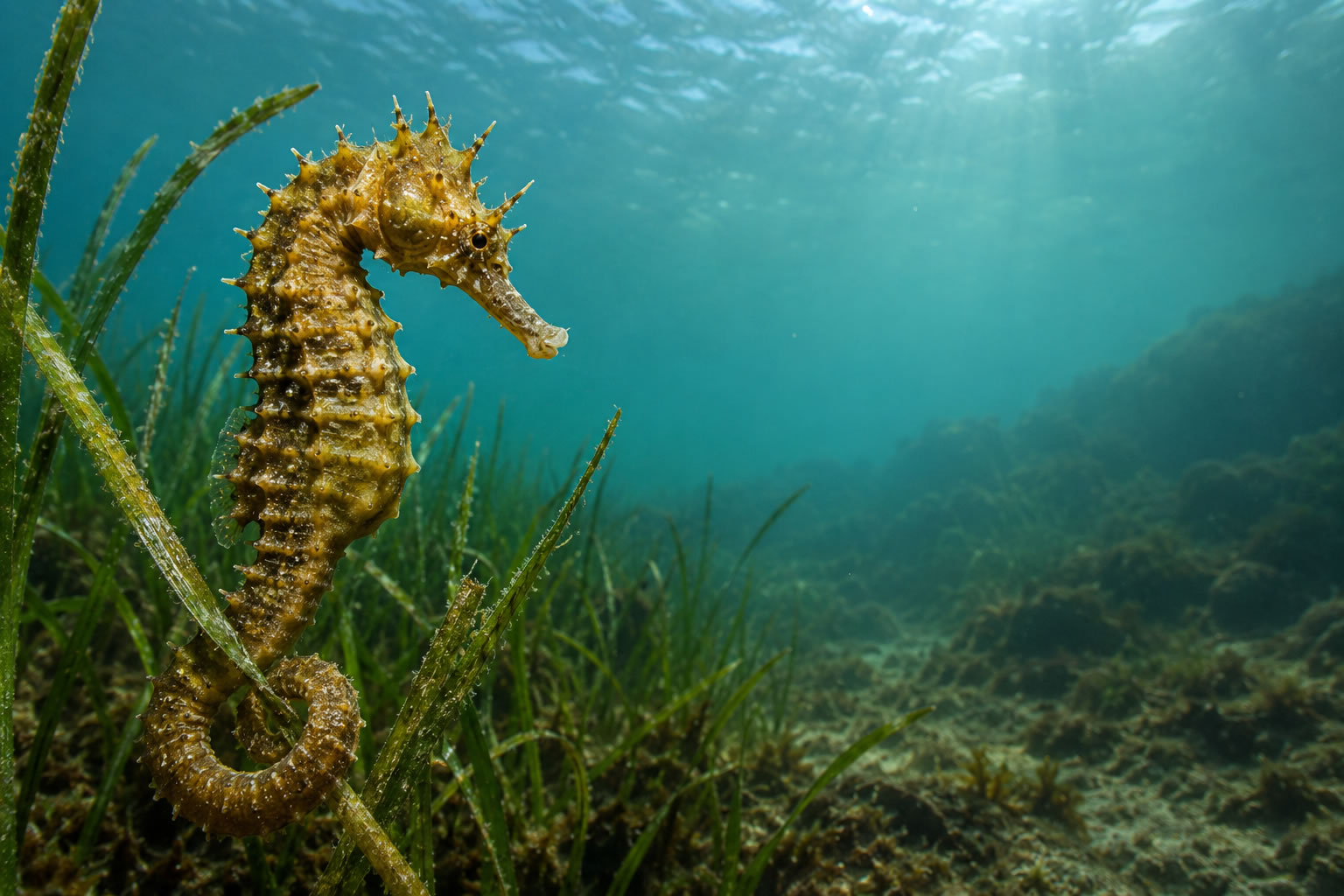
There is something almost unreal about a seahorse. It looks as if it belongs in folklore as much as in science. It drifts rather than charges. It clings rather than hunts. It seems delicate, but it survives in a world of tide, weed, mud, predator and storm. That contradiction made it irresistible to write about. For Gareth Rhys, a 55-year-old investigative reporter with a habit of asking one question too many, the seahorse is exactly the sort of creature that would draw him in. Small. Overlooked. Easy to dismiss. Yet connected to something much bigger.
That is what I enjoyed most. The novel allowed me to put Gareth in familiar Welsh settings while giving him a mystery that reached beyond Wales. A cold box is a simple object. It might sit on a quay, in a van, in a warehouse, in a fish market, or in the back room of a perfectly respectable business. Yet inside it could be evidence of cruelty, greed and international crime. That contrast gave the story its tension. It allowed the book to move from the coast to the docks, from ordinary working lives to organised smuggling, and from local suspicion to global consequence.
Seahorses are at risk because they sit at the meeting point of several pressures. They depend on healthy coastal habitats, including seagrass meadows, estuaries and sheltered marine environments. When those habitats are damaged by pollution, development, dredging, anchoring, warming seas or poor water quality, seahorses lose the places where they feed, shelter and breed. They are also threatened by capture for the aquarium trade, the curio trade and traditional medicine markets. All seahorse species are covered by CITES trade controls, but research has shown that the trade in dried seahorses remains vast and much of it is now smuggled across borders.
That fact gave the novel a sharp moral centre. I did not want to write a lecture. I wanted to write a thriller. But the best environmental fiction does not need to stop the story to make its point. It lets the reader feel what is at stake. A dead animal in a box. A missing shipment. A nervous witness. A family business under pressure. A reporter who realises that a minor lead is not minor at all. Those are the moments where fiction can carry truth.
The illegal wildlife trade is often associated with animals that have become symbols of global conservation: elephants, rhinos, tigers, pangolins. Seahorses rarely get the same public attention. That makes them especially powerful in a novel. They are easy to underestimate, just as Gareth is sometimes underestimated. But the figures around the trade are disturbing. In a House of Commons debate on illegal seahorse trade, MPs heard estimates that tens of millions of seahorses are taken from the wild each year for traditional medicine, curios and aquariums, with higher estimates from conservation groups suggesting a still larger hidden trade.
For a novelist, those facts create a troubling question: how does something so small become worth smuggling? The answer is greed, demand and invisibility. A seahorse is not noisy. It does not roar. It does not fill a lorry. Dried seahorses can be packed, hidden, labelled falsely and moved through supply chains. That makes them ideal material for a Gareth Rhys story. Gareth is interested in the overlooked detail. The odd invoice. The wrong label. The person who says too much. The person who says nothing.
I also enjoyed writing The Cold Box Seahorses because it let me celebrate Wales as a place of mystery, beauty and danger. Wales is not just a backdrop in the Gareth Rhys series. It is part of the story’s engine. Its coasts, docks, estuaries, towns and rural communities all shape the plot. A crime in Wales feels different when it grows out of Welsh geography. The Pembrokeshire coast, the Severn Estuary, the industrial memory of South Wales and the working atmosphere of ports all offer texture. They give the book weather, smell, salt, mud and history.
Welsh waters are home to both native UK seahorse species: the spiny or long-snouted seahorse and the short-snouted seahorse. Both are protected under UK law, including Section 9 of the Wildlife and Countryside Act 1981, and are also covered by trade regulations. Natural Resources Wales lists both the spiny seahorse and the short-snouted seahorse among UK fish protected by law. That matters because protection is not just about stopping someone from taking an animal. It is also about recognising that the animal belongs to an ecosystem, and that damaging its home can be just as serious as removing the creature itself.
The Welsh Wildlife Trusts describe both the long-snouted and short-snouted seahorse as UK Priority Species, with the long-snouted seahorse associated with shallow coastal waters and seagrass habitats. The short-snouted seahorse is also identified as a protected species and a feature of conservation importance for which Marine Conservation Zones can be designated. These are not abstract labels. They show that seahorses are part of a bigger conservation picture. Protect seahorses and you are also thinking about seagrass, water quality, fish nurseries, coastal resilience and the health of the sea itself.
That is why the conservation work now being done in Wales is so encouraging. Seahorse conservation is closely tied to seagrass restoration, because seagrass meadows provide vital shelter and feeding grounds for many marine species. In January 2025, the Welsh Government announced funding to develop a National Seagrass Action Plan for Wales and noted that almost £1.12 million had already been awarded to seagrass and saltmarsh restoration projects since 2021. That sort of work gives hope. It shows that conservation is not only about stopping harm, but about rebuilding what has been lost.
There is also practical restoration taking place around Wales. Project Seagrass has been exploring restoration potential in areas including Llanelli and Cardiff, working with Special Area of Conservation officers in Pembrokeshire, Carmarthenshire Bays and Estuaries, and the Severn Estuary. In north Wales, Seagrass Ocean Rescue has been linked to a project to restore 10 hectares of seagrass around the Llŷn Peninsula and Anglesey. These projects may sound technical, but at their heart they are simple: give the sea back some of the nursery habitat it has lost.
One of the most heartening pieces of recent news came from the wider UK picture. In 2025, volunteer divers at Studland Bay in Dorset recorded a surge in seahorse sightings after years of work to protect seagrass, introduce eco-friendly moorings and reduce anchor damage. The bay is home to both UK seahorse species, and the Seahorse Trust’s long-running work there shows what can happen when protection, monitoring and community effort come together. Although that example is outside Wales, it is highly relevant to Welsh conservation. It proves that seahorse habitats can recover when people give them a chance.
Wales has its own role to play in that recovery story. The development of a national seagrass plan, restoration projects in south and north Wales, and the work of marine conservation organisations all point in the right direction. Recent reporting has also highlighted the importance of UK seagrass restoration, including work at sites such as Penrhyn beach on Ynys Môn and Dale in South Wales, with Wales described as aiming for significant seagrass restoration by 2030. For a writer of eco-thrillers, this is rich ground. It gives the story both danger and hope.
That balance matters to me. I do not want the Gareth Rhys books to be bleak for the sake of it. They deal with crime, cruelty and corruption, but they also deal with people who care. Reporters. Volunteers. scientists. campaigners. Police officers doing their best. Local people who know a stretch of coast better than any official map. In The Cold Box Seahorses, I wanted the reader to feel the pressure of illegal trading, but also the value of those who refuse to look away.
Gareth Rhys is a good character for this kind of story because he is old enough to have seen Wales change, and stubborn enough to keep asking what those changes cost. He is not a superhero. He is a working journalist with experience, doubts and persistence. That makes him useful. He can walk into a harbour café, a council office, a police press briefing or a windswept coastal path and notice what does not fit. I enjoyed writing him in this novel because the subject suited his strengths. Seahorse trafficking is not a crime solved by brute force. It is solved by patience, observation and following the trail.
Writing the book also reminded me why eco-thrillers matter. They can entertain, but they can also make readers curious. A reader might come for the mystery and leave knowing that seahorses live in British and Welsh waters. They might learn that illegal wildlife trade is not only a distant problem. They might look differently at seagrass, docks, coastlines and conservation. That is a worthwhile thing for fiction to do.
Most of all, I enjoyed writing The Cold Box Seahorses because it gave me the chance to place a fragile creature at the centre of a tough story. Seahorses are small, but the issues around them are not. They speak to habitat loss, organised crime, global trade, local responsibility and the deep connection between Wales and the sea.
For Gareth Rhys, the mystery begins with a cold box.
For me, it began with a question.
What happens when something delicate is treated as cargo?
The answer became a novel.