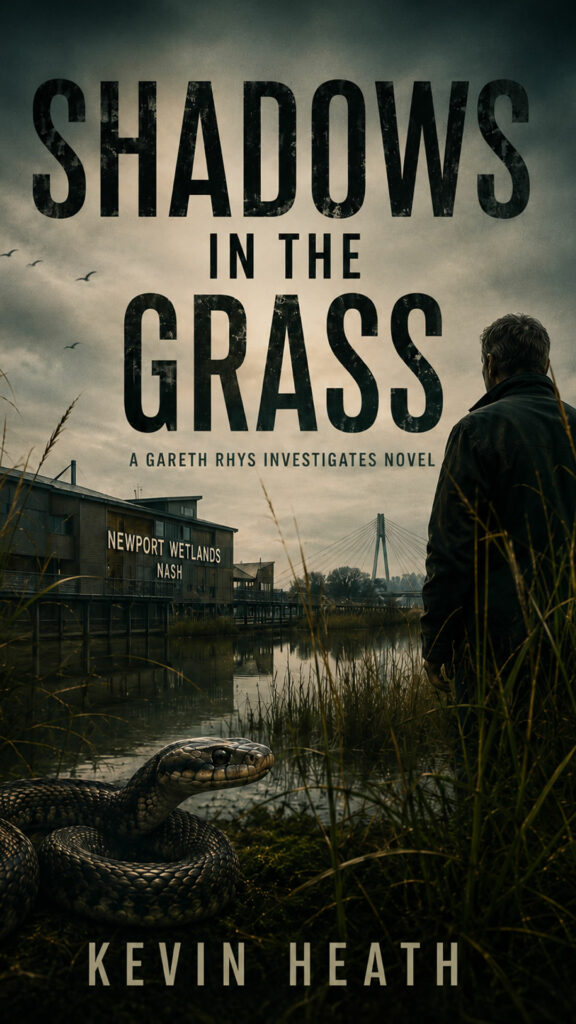
Shadows in the Grass
NEW
Shadows in the Grass

Part of the Gareth Rhys Investigations series:

A body is discovered in the reedbeds of the Newport Wetlands.

At first glance, it appears to be a tragic and unusual death. But investigative journalist Gareth Rhys quickly notices something that doesn’t fit - a strange wound unlike anything local police have encountered before.

For Gareth, who has spent decades uncovering the hidden crimes operating beneath rural life in South Wales, instinct matters. And his instincts tell him this death is only the beginning.

As questions spread across Newport and the villages of the Gwent Levels, Gareth finds himself drawn into a world few people ever see, one where exotic wildlife is bought and sold through hidden networks, dangerous animals vanish into the illegal pet trade, and quiet businesses conceal far darker activities beneath the surface.

Working uneasily alongside Acting Detective Inspector Sara Llewellyn, Gareth follows a trail that leads from pet shops and isolated farms to bonded warehouses, abandoned buildings, and whispered rumours moving through rural communities. The deeper he digs, the clearer it becomes that powerful people have invested heavily in keeping certain truths hidden.

But Gareth is not the only one under pressure.

In the village of Nash, elderly wildlife rescuer Bethan “Draenog” has begun facing intimidation designed to force her from her home beside the wetlands she has spent a lifetime protecting. Around her, tensions over land, money, and development are beginning to boil over, exposing long-standing divisions beneath the quiet surface of village life.

As the investigation gathers momentum, Gareth must navigate a dangerous landscape where organised crime, local loyalties, and hidden violence collide, and where asking the wrong questions can have deadly consequences.

Set against the haunting beauty of the South Wales coast and the windswept Gwent Levels, this atmospheric crime thriller combines investigative journalism, rural noir, and environmental crime into a gripping mystery filled with tension, danger, and richly drawn characters.

Perfect for readers who enjoy:

  • Atmospheric British crime fiction
  • Investigative mystery thrillers
  • Rural noir and Welsh crime novels
  • Slow-burning suspense with strong sense of place
  • Wildlife and environmental crime stories
  • Character-driven mysteries with realistic investigative detail

The Gareth Rhys Investigates series follows an experienced Welsh journalist uncovering the hidden crimes operating beneath ordinary rural life - where silence, money, and power often matter more than truth.

Published:
Genres:
Excerpt:

Chapter 1

The path narrowed as it dipped between the reeds, the sound of the road fading behind them until it was replaced by the softer, more constant rhythm of wind and water. Gareth walked slightly behind the main group, hands in his jacket pockets, letting the conversation drift around him without fully joining it. The morning had settled into something unexpectedly warm - sunlight breaking clean across the wetlands, catching on the pale greens and golds of new growth. It was the kind of day that felt borrowed, as though spring had arrived early and might change its mind at any moment.

READ MORE

Lowri walked beside him, more engaged than he was, nodding along as one of the others spoke about a recent community event - something involving pottery classes and a charity raffle. The group itself was typical of the local council’s lifestyle initiative: a mix of ages, most of them familiar with one another, drawn together by routine as much as interest. The walks had become a quiet fixture in the week, something Lowri had suggested more than once before Gareth had finally agreed.

“It’s good for you,” she had said. “An hour without chasing something.”

He hadn’t argued. Not properly. And now, here he was - following a line of people along a raised path through reedbeds, listening to the low murmur of conversation and the occasional call of birds lifting somewhere out over the water.

Ahead, one of the group leaders, Carys, he thought her name was, slowed slightly, raising a hand to steady herself as the path curved. She was in her forties, practical, organised, the kind of person who kept things moving without appearing to push. Today, she’d been pointing out early nesting activity, drawing attention to subtle changes in the landscape that most would have missed.

“…if you look just beyond that break in the reeds,” she was saying, gesturing out toward the open stretch beyond, “you can usually…”

She stopped.

It wasn’t abrupt, not at first. More a hesitation, as though she’d lost her place mid-sentence. Then she took a step forward, narrowing her eyes slightly, her focus fixed somewhere out beyond the low wall that marked the edge of the path.

“What is it?” someone asked.

Carys didn’t answer immediately. She moved closer to the wall, resting a hand on its weathered stone, and leaned forward slightly.

“There’s… something down there.”

The group quietened almost instinctively. Conversations fell away, replaced by a shared, uncertain attention. Gareth felt it too, that subtle shift when something didn’t quite fit.

He stepped forward, closing the distance to the wall. Beyond it, the land dropped away into a stretch of mudflat, still exposed at this point in the tide cycle. The surface was uneven, ridged and dark, marked by shallow channels where water had recently receded. Beyond that, further out, the estuary caught the sunlight in a dull shimmer.

At first, he didn’t see it. Then his eyes adjusted. A shape, lying just above the high tide mark. Not large, but distinct enough once you knew where to look. Something out of place against the natural pattern of the mud.

“Is that…?” someone began.

Carys took a breath, steadying herself. “I think it might be a person.”

The words settled heavily. No one spoke for a moment.

Lowri moved closer to Gareth, her shoulder brushing his. “Can you see it properly?”

He didn’t answer straight away. He was already leaning forward, narrowing his gaze, letting instinct take over where uncertainty had been.

“Yes,” he said quietly. “I can see it.”

There was a stillness to the shape that didn’t belong to someone resting. No movement, no shift with the breeze. The position was wrong too - angled slightly, one arm out from the body in a way that suggested collapse rather than intention.

Carys was already reaching for her phone. “I’m calling it in,” she said, her voice controlled but tighter now. “Everyone just stay back from the wall, please.”

A few of the group stepped away instinctively, as though distance might make it less real. Others remained where they were, watching.

Gareth didn’t move back. He studied the drop beyond the wall. It wasn’t sheer, but it was steep enough to require care. The mud below looked firm in places, softer in others -unpredictable.

“Gareth,” Lowri said quietly, recognising the shift in him before he’d even acted.

He glanced at her briefly. “I’m just going to take a closer look.”

“The police are on their way.”

“I know.”

There was a pause, familiar, unspoken.

Then he turned, placing a hand on the top of the wall. The stone was warm under his palm. He swung one leg over, testing his footing on the other side before committing his weight. The drop was awkward rather than dangerous, but the mud shifted slightly as he landed, forcing him to adjust quickly to keep his balance.

Behind him, he heard Lowri’s voice, sharper now. “Gareth…”

But he was already moving.

He picked his way across the mudflat carefully, placing each step with intention, avoiding the darker patches that might give way under pressure. The air felt different down here -closer, heavier, the faint scent of salt and decay rising from the exposed ground.

The body lay ahead, unchanged. As he drew closer, details began to resolve.

A man. Mid-forties, perhaps older. Dressed in everyday clothing: jeans, a jacket, nothing immediately distinctive. He was lying on his side, one arm bent beneath him, the other stretched slightly forward as though he’d tried to steady himself before falling.

Gareth slowed as he approached, stopping a short distance away. He didn’t touch the body. Didn’t kneel immediately. Just stood for a moment, taking it in.

There were no obvious signs of injury. No blood visible. No disturbance in the mud around him that suggested a struggle. The surface nearby was marked, but not in a way that told a clear story.

He crouched slowly, lowering himself into a more stable position.

“Gareth.”

He turned his head slightly. Lowri was making her way toward him, more cautiously than he had, testing each step before committing. He watched her for a moment, a flicker of concern crossing his expression, but said nothing.

She reached him and stopped just behind his shoulder, her breathing slightly uneven from the effort of the descent.

“You shouldn’t have come down,” he said quietly.

“Neither should you.”

There was no heat in it. Just fact.

They both looked back at the body.

“What do you think?” she asked.

Gareth didn’t answer immediately. He shifted slightly, adjusting his position to get a clearer view without getting too close. “Look at the ground,” he said.

Lowri followed his gaze. “There’s not much disturbance.”

“No.”

“Could have been carried?”

“Possibly.”

He leaned forward slightly, careful not to let his shadow fall too heavily across the body. His eyes moved methodically: face, clothing, hands.

Then he stopped. “Lowri,” he said quietly.

She leaned in slightly. “What is it?”

“His hand.”

The man’s right hand lay partially turned upward, fingers slightly curled. The skin was swollen, discoloured - an unnatural darkening that stood out even against the general pallor.

Lowri frowned. “That doesn’t look right.”

“No.”

Gareth shifted his position again, angling himself to see more clearly. He didn’t touch the hand, but he leaned close enough to examine it properly.

The tissue around the centre of the hand was blackened, dead. At its core, a puncture mark. Deep, clean, unmistakable once you knew what you were looking at.

He felt a quiet certainty settle into place. “Do you see it?” he said.

Lowri nodded slowly. “Yes.” There was a pause. “What do you think it is?” she asked.

Gareth lowered his voice, instinctively, as though the reeds themselves might carry the words. “I think it’s murder.”

Lowri didn’t react outwardly. She didn’t step back or draw in breath sharply. She just looked at the hand again, then back at Gareth.

“Murder?” she repeated, quietly.

He nodded once. “That didn’t happen naturally,” he said. “Not here.”

Her eyes narrowed slightly. “What caused it?”

Gareth hesitated for a fraction of a second, not because he didn’t know, but because saying it would make it real in a different way.

He pointed, subtly, to the centre of the damaged tissue. “That,” he said. “That’s a bite.”

Lowri looked again, more carefully this time. “An animal?”

“Not local.” He straightened slightly, shifting his weight back. “I’ve seen similar before,” he said. “Not often. But enough.”

“Where?”

“Investigations. Africa, mostly. Once here….” He paused. “Illegal collections”

Lowri’s gaze flicked back to the body, then out across the wetlands. “A snake?” she said.

Gareth met her eyes. “Yes.”

She held his gaze for a moment. “You’re sure?”

He shook his head slightly. “No. Not yet.” A beat. “But it looks like one. And not just any snake.”

Lowri glanced back toward the wall. The group was still gathered there, smaller now against the wide openness of the landscape. Carys stood slightly apart, phone still to her ear.

“The police will be here soon,” Lowri said.

Gareth nodded. “They should be.”

He looked back at the body, the stillness of it, the quiet wrongness of its placement. “It’s dry,” he added.

Lowri followed his line of thought. “So it hasn’t been washed in.”

“No. If it had, there’d be more disturbance. Debris. Movement.”

“So it was put here.”

“Yes.”

He let the implication settle between them.

Lowri folded her arms loosely, not from cold, but from something more instinctive—containment. “This wasn’t random,” she said.

“No.”

“And whoever did it thought the tide would take it.”

Gareth nodded again.

“But they misjudged,” she added.

“Or ran out of time.”

They stood in silence for a moment, the breeze moving lightly through the reeds behind them, the distant sound of birds carrying faintly across the water.

From somewhere above, a voice called down - Carys again, strained but steady.

“The police are on their way! They’ve asked everyone to stay where they are.”

Gareth didn’t look up. His attention had already shifted beyond the body, beyond the immediate. A man, brought here. Left in the open, but not quite exposed. Killed in a way that didn’t belong to this place.

He felt it then - that familiar, quiet pull. Something didn’t fit. And whatever had brought it here… Wasn’t finished.


Chapter 2

The first of the police vehicles arrived without urgency but with purpose, tyres crunching lightly on the gravel before settling near the entrance track. The quiet of the wetlands shifted - not broken, exactly, but altered. Conversations above the wall picked up again in low, uncertain tones as uniformed officers began guiding the walking group back from the edge.

Gareth heard the footsteps before he saw her.

“Of course,” Acting Detective Inspector Sara Llewellyn said, her voice carrying just enough to reach him without rising. “You’d already be here.”

He glanced over his shoulder. She was making her way down from the wall with more care than hesitation, one hand steadying herself as she dropped onto the mud. Behind her, two members of the forensic team waited at the top, assessing their route down.

“You took your time,” Gareth replied.

Sara didn’t react to that. She stepped onto firmer ground, testing it once before moving forward. Her expression was composed, as it always was, eyes already scanning, taking in the scene in pieces rather than as a whole.

She stopped a few feet from the body, then turned slightly. “Lowri.”

Lowri stepped forward from where she’d been standing beside Gareth. “Sara.”

They knew each other well enough for the greeting to carry weight without warmth.

“What did you see?” Sara asked.

Lowri kept her answer measured. “We were walking the path. One of the group leaders spotted something from the wall. We came closer. Gareth climbed down first.”

Sara’s gaze flicked briefly to Gareth, then back again. “And you followed.”

“Yes.”

“Did either of you touch the body?”

“No,” Lowri said. “We kept our distance.”

Sara nodded once. “Good.”

There was a brief pause as one of the forensic officers approached, crouching near the edge of the mudflat with a kit bag, waiting for instruction. Sara held up a hand slightly, wait.

She looked back at Lowri. “I’m going to need you to go back up to the path. There’ll be a constable taking statements from the group. Just tell them exactly what you’ve told me.”

Lowri hesitated, her eyes flicking briefly to Gareth. “It’s fine,” he said quietly.

She held his gaze for a moment, then nodded. “All right.”

Sara stepped aside to give her space. “Take your time going back up,” she added. “It’s not stable underfoot.”

Lowri gave a small nod of acknowledgement and turned, picking her way carefully back across the mud. Sara watched her for a second longer, then turned back. And fixed Gareth with a steady look. “Right,” she said. “Why are you on a crime scene?”

Gareth didn’t answer immediately. He was still looking at the body.

“You should know better,” Sara continued. “This isn’t your patch to wander into.”

He crouched slightly, shifting his position without acknowledging the question. “You’ll want to make sure that hand’s protected.”

Sara didn’t move. “Gareth.”

He gestured subtly toward the body. “The right hand. Get them to prioritise it.”

Sara followed the line of his gesture despite herself. Her eyes settled on the swollen, discoloured hand.

“I’ve already seen it,” she said. “We’ll process everything properly.”

“It’s not just part of the scene,” Gareth replied. “It’s the scene.”

One of the forensic officers edged closer, waiting for direction. Sara glanced briefly at him, then back to Gareth. “What exactly are you suggesting?”

Gareth shifted slightly, angling himself so she could see more clearly without stepping closer. “Look at the tissue,” he said. “The swelling. The necrosis.”

Sara crouched, careful not to disturb the ground, her eyes narrowing as she examined the hand more closely. “It could be an infected bite,” she said. “Insect, maybe. Something that’s turned.”

Gareth shook his head. “Not like that.”

Sara didn’t look up. “You’ve decided that already, have you?”

“I’ve seen it before.”

That made her pause. She glanced up at him now, properly. “Where?”

“Different places,” he said. “Investigations. Not here.”

She looked back at the hand. “What are you saying?”

Gareth lowered his voice slightly. “You’ll need toxicology.”

Sara gave a faint, almost impatient breath. “We’ll be doing a full post-mortem.”

“For venom,” he added.

That made her still. “Venom,” she repeated.

“Yes.”

Sara looked back at the hand again, more intently this time. Her expression shifted, not alarmed, but sharpened.

“You’re suggesting a snake bite,” she said.

“I am.”

She leaned in slightly, studying the wound. “Forensics will pick up anything unusual,” she said, though there was less certainty in it now.

“Make sure they test for it,” Gareth said. “Specifically.”

Sara straightened slightly, looking at him again. “Why?”

Gareth pointed, not touching, just indicating. “Look at the puncture marks,” he said.

Sara’s eyes followed.

“There are two,” he continued. “Deep. About a centimetre apart.”

She leaned closer again, measuring it visually. “Could be anything.”

“Eleven millimetres,” Gareth said. “Roughly.”

She frowned slightly.

“The swelling’s too extensive,” he went on. “And it’s localised around the bite. Blistering. Tissue’s already dying.”

Sara’s gaze moved across the hand again, slower now.

“And look at the bruising,” Gareth added. “That darkening, it’s not just pooling. It’s damage.”

Sara didn’t respond immediately.

“And his face,” Gareth said. She glanced up at him. “The eyebrows,” he said. “Swelling there too. It’s systemic.”

Sara studied him for a moment. “You’ve thought this through.”

“I didn’t need to.”

She looked back at the body, then at the hand again. “You’re certain?” she asked.

Gareth shook his head once. “Nothing’s certain.” A beat. “But it fits.”

Sara stood slowly, brushing her hands lightly against her jacket as she did. “If this is a snake bite,” she said, “we’re a long way from where that makes sense.”

“Yes.”

“So why that conclusion?”

Gareth held her gaze for a moment. “Because of the size of the punctures,” he said. “And the damage.”

Sara’s eyes narrowed slightly. “Go on.”

He exhaled slowly. “If I had to guess,” he said, “I’d say it’s a viper.”

Sara said nothing.

“And not a small one.”

She folded her arms loosely. “You’re narrowing it down further.”

Gareth nodded. “It’s not something native. Not even close.”

“What, then?”

He hesitated for a fraction of a second. “Gaboon viper.”

Sara’s expression didn’t change, but there was a flicker behind it. “A what?”

“Gaboon viper,” he repeated.

She stared at him. “You’re serious.”

“Yes.”

Sara let out a quiet breath, somewhere between disbelief and consideration. “Explain that,” she said.

Gareth shifted his weight slightly, glancing briefly toward the estuary before looking back at her. “They’re found in central Africa,” he said. “Rainforests, mostly. Dense cover. They’re not aggressive, don’t tend to strike unless provoked.”

“And you think one’s turned up here?” Sara said.

“No,” Gareth said. “I think the bite matches.”

She waited.

“They’re one of the largest vipers,” he continued. “Huge fangs. That spacing, it fits.”

Sara glanced back at the hand again.

“They don’t strike and release like some species,” Gareth said. “They hold on. That means they deliver a lot of venom.”

“How much is ‘a lot’?” she asked.

“More than most,” he said. “Possibly more than any other viper.”

Sara’s jaw tightened slightly. “Effects?”

“Cellular damage,” Gareth said. “Tissue destruction. That’s what you’re seeing there.” He nodded toward the hand. “But also, cardiovascular impact,” he added. “It interferes with heart function.”

Sara listened without interrupting.

“There are reports,” Gareth went on, “of fatalities within fifteen minutes.”

Sara raised an eyebrow slightly. “Reports.”

“More typically within hours,” he said. “Up to a day if untreated.”

“And if treated?”

Gareth gave a small, humourless breath. “If treated quickly, survival’s possible. But often at a cost.”

“What kind of cost?”

He glanced at the hand again. “Amputation,” he said.

Sara was quiet for a moment. Behind them, one of the forensic officers shifted, still waiting.

Sara turned slightly. “Make a note,” she said to him. “We’ll need toxicology screening for venom.” The officer nodded, already writing. “And flag for the pathologist,” she added. “Full analysis. Species identification if possible.”

“Yes, ma’am.”

Sara turned back to Gareth. “A Gaboon viper,” she said, more to herself than to him. “In Newport.”

Gareth shook his head. “I didn’t say that.”

She looked at him. “You implied it.”

“I said the bite matches.”

“Which brings us back to the same question,” Sara said. “What would one be doing here?”

Gareth held her gaze. “It wouldn’t be,” he said.

Sara looked past him, out across the mudflats, then back toward the wall. “People release animals,” she said. “Exotic pets. Happens.”

“Yes,” Gareth said. “It does.”

“But not this,” she said.

“No.”

They stood in silence for a moment. Sara took a slow breath, then let it out. “Let’s assume,” she said, “that the bite is what you think it is.”

Gareth said nothing. She gestured lightly around them. “This location doesn’t support it.”

“No.”

“The ground’s soft,” she continued. “Unstable. Difficult to move across.”

Gareth nodded slightly.

“If someone was attacked here,” she said, “we’d expect disturbance. Signs of movement. Struggle.”

“There isn’t any,” he said.

“No.”

She looked back at the body. “And if this happened elsewhere,” she went on, “then whoever brought him here had a reason.”

“To get rid of him,” Gareth said.

“Yes.” She pointed toward the waterline. “The tide.”

Gareth followed her gaze.

“They’d expect it to take the body,” she said. “Carry it out.”

“But it hasn’t,” Gareth replied.

Sara nodded. “He’s above the usual line,” she said. “That water won’t reach him except on a high spring tide.”

Gareth looked back at the body again. “So they either misjudged,” he said, “or they didn’t have time.”

Sara’s expression remained steady. “Carrying a body across this,” she added, gesturing to the mud, “wouldn’t be easy.”

“No.”

“Dangerous, even.”

“Yes.”

“So they didn’t go far,” she said.

Gareth didn’t respond. Sara looked at him. “Which means,” she said, “this started somewhere close.” A pause. “And ends with a post-mortem,” she added. “Until we know what we’re dealing with.”

Gareth straightened slightly, glancing back toward the wall where the rest of the group waited. Sara followed his gaze briefly, then looked back at him. “You’re done here,” she said.

Gareth didn’t argue. But he didn’t move immediately either.

Sara held his gaze for a moment longer. “Don’t get ahead of this,” she said quietly.

Gareth gave a faint, almost unreadable look. “Too late,” he replied.

Sara watched him for a second, then turned away, already shifting her attention back to the scene, to the work, to the structure she could control. Behind her, Gareth finally stepped back from the body. But his eyes didn’t leave it. Not yet.


Chapter 3

The newsroom carried a different kind of noise to the wetlands - constant, low-level, shaped by movement rather than wind. Phones rang without urgency, keyboards tapped in uneven rhythms, and somewhere toward the back, a printer stuttered through another batch of pages. It was late afternoon, the light outside flattening into that dull grey that followed a clear morning, as if the day had already decided it had done enough.

Gareth paused just inside the entrance, letting his eyes adjust, not to the light but to the shift in pace. The quiet of the reedbeds still sat with him, not yet displaced by the busier, more contained energy of the office. He moved through the rows of desks without speaking, nodding briefly to one or two people who glanced up. Most didn’t. Deadlines had a way of narrowing focus.

Elin’s office sat at the far end, glass-fronted but not fully transparent - blinds half-drawn, enough to suggest separation without shutting it off entirely. The door was closed.

He knocked once.

“Come in.”

He pushed the door open.

Elin Morgan was at her desk, glasses low on her nose, a stack of printed pages spread out in front of her, marked heavily in pen. She didn’t look up immediately.

“You’re late,” she said.

“For what?”

“For whatever it is you’re about to tell me you’ve been working on all day.”

Gareth closed the door behind him. “You asked. for me to come in.”

“I didn’t say I was pleased about it.”

That drew the faintest hint of a smile from him, though it didn’t last.

She looked up then, properly, studying him for a moment. “You’ve been out,” she said.

“Yes.”

“Where?”

Gareth pulled a chair slightly away from the wall, but didn’t sit straight away. “The wetlands.”

Elin’s expression didn’t change. “Which wetlands?”

“Newport.” A pause.

“What were you doing there?”

“Walking.” That earned him a look. “With Lowri,” he added. “Council group. Weekly thing.”

Elin leaned back slightly in her chair, folding her arms. “And I assume you didn’t just come back to tell me about the benefits of fresh air.”

Gareth sat now, leaning forward slightly, forearms resting on his knees. “They found a body.”

Elin didn’t react immediately. She held his gaze for a second, then reached for a pen and set it down again without writing. “Where?”

“In the reedbeds, just out from the path. On the mudflats.”

“Who found it?”

“One of the group leaders. We were about halfway through the walk.”

“And you were there when it was discovered.”

“Yes.”

Elin nodded once, slowly. “Police?”

“Called straight away. They were on scene within the hour.”

“And you stayed.” It wasn’t a question.

“Yes.” Another pause.

“What do we know?” she asked.

“Not much that’s confirmed,” Gareth said. “Male. Mid-forties, maybe older. No obvious external trauma.”

Elin watched him closely. “And the part that isn’t confirmed?”

Gareth hesitated for a fraction of a second. “I think he was killed.”

Elin didn’t move. “Based on?”

“The placement,” Gareth said. “The lack of disturbance. He was put there.”

“That’s not the same as cause of death.”

“No.”

“So what are you suggesting?”

Gareth held her gaze. “A bite.”

Elin’s expression tightened slightly. “From what?”

“A snake.”

That hung in the air for a moment. Elin leaned back a little further in her chair, studying him. “You’re serious.”

“Yes.”

“On what basis?”

“The wound,” Gareth said. “Right hand. Severe swelling. Tissue damage. Two puncture marks.”

“Elaborate.”

Gareth shifted slightly in his chair. “The spacing of the punctures, about a centimetre apart. Deep. Not superficial.”

Elin said nothing, waiting.

“The surrounding tissue was already necrotic,” he continued. “Blackened. Blistering. Significant bruising.”

“And that leads you to a snake.”

“Yes.”

Elin tilted her head slightly. “Or an infected bite. Or any number of other possibilities.”

“It’s possible,” Gareth said. “But it doesn’t fit as well.”

Elin tapped the pen lightly against the desk once, twice.

“Have the police confirmed any of this?”

“No.”

“So at the moment,” she said, “this is your interpretation.”

“Yes.”

“Backed by?”

Gareth didn’t hesitate. “Experience.”

Elin’s eyes narrowed slightly. “That’s not evidence.”

“No.”

“It’s not even particularly useful in a courtroom.”

“I’m not in a courtroom.”

“You’re in a newsroom,” she said, evenly. “Which isn’t that different when it comes to what we can and can’t say.”

Gareth sat back slightly, exhaling. “We’re waiting on the pathologist,” he said. “They’ll confirm cause of death.”

“And until then?”

He met her gaze. “We look at what’s there.”

Elin held his eyes for a moment longer, then leaned forward, resting her elbows on the desk. “Go on,” she said.

Gareth nodded slightly. “If it is a snake,” he said, “it’s not native.”

“That’s a safe assumption.”

“And not small.”

Elin’s pen stilled. “You’ve already narrowed it down.”

Gareth hesitated, then said it. “It looks like a viper.”

Elin didn’t react outwardly, but her attention sharpened. “What kind of viper?”

“A large one.”

“That’s vague.”

Gareth held her gaze. “Gaboon viper.”

There was a longer pause this time. Elin sat back again, the pen lowering slowly to the desk. “A Gaboon viper,” she repeated.

“Yes.”

“In Newport.”

“I didn’t say it was in Newport,” Gareth said. “I said the bite looks like one.”

Elin studied him carefully. “And what, exactly, do you expect me to do with that?” she asked.

“Nothing yet.”

“Good,” she said. “Because we are not publishing a story about a killer snake in the wetlands based on what you think you saw.”

“I didn’t suggest we should.”

“You implied it.”

“No,” Gareth said. “I’m telling you what it might be.”

Elin leaned forward again, her voice firmer now. “Let me be clear,” she said. “We are not going to frighten people with speculation. Not on something like this.”

Gareth nodded once. “I agree.”

She held his gaze, as if testing whether he meant it. “Then what are you asking for?” she said.

“Time,” Gareth replied. “And space to follow it.”

Elin didn’t respond immediately.

Gareth continued. “If it is what it looks like,” he said, “then it doesn’t stop at the wetlands.”

Elin’s expression didn’t change. “Explain.”

Gareth leaned forward again. “Exotic species in the UK aren’t unusual,” he said. “Not in captivity.”

“That’s not new.”

“No,” Gareth agreed. “But it’s regulated. Dangerous species - vipers included - have to be licensed.”

Elin nodded slightly. “Under what legislation?”

“The Dangerous Wild Animals Act 1976.”

She gave a faint, approving tilt of the head. “Go on.”

“Owners have to register with the local council,” Gareth said. “Secure enclosures. Inspections. Conditions to prevent escape.”

“And how many are we talking about?”

“Licensed?” Gareth said. “Roughly six thousand animals across the UK. Everything from snakes to big cats.”

Elin’s eyebrows lifted slightly. “Big cats.”

“Yes.”

“And specifically snakes?”

“Over four hundred dangerous snakes licensed.”

Elin tapped the pen again, lightly. “And unlicensed?”

Gareth gave a small breath. “That’s where it gets less precise.”

“How less precise?”

“Estimates vary,” he said. “But some put it as high as a million exotic animals being kept without licences.”

Elin stared at him for a moment. “A million.”

“Across the UK,” Gareth said. “Not all dangerous. But enough.”

She leaned back again, processing that.

“The legal trade alone,” Gareth added, “is worth over two hundred million pounds.”

Elin’s gaze sharpened slightly. “Annually?”

“Yes.”

“And illegal?”

Gareth shook his head. “Harder to quantify. But it’s there.”

Elin was quiet for a moment. “And you’re suggesting this could be connected.”

“I’m saying it could be part of something wider,” Gareth said.

Elin’s fingers tapped once against the desk, then stilled. “People keep exotic pets,” she said. “That’s not a story on its own.”

“No,” Gareth agreed. “But what happens when they can’t?”

Elin looked at him.

“They’re expensive,” he said. “Difficult to manage. Dangerous, in some cases.”

“So they get rid of them.”

“Yes.”

“How?”

“Sometimes legally,” Gareth said. “Rehoming. Specialist facilities.”

“And sometimes?”

“They release them.”

Elin’s expression didn’t shift, but there was a flicker of recognition there.

“In parks,” Gareth went on. “Woodland. Wetlands. Anywhere they think they won’t be found.”

Elin exhaled slowly through her nose. “We’ve heard that before,” she said. “Big cats in the countryside. Sightings every few years.”

“Beast of Bodmin Moor,” Gareth said.

Elin gave a faint, dismissive look. “Rarely substantiated.”

“Usually not,” Gareth agreed. “But not always entirely baseless.”

She said nothing.

“The snapping turtles,” Gareth added.

Elin frowned slightly. “What about them?”

“Brought in during the craze,” he said. “Teenage Mutant Ninja Turtles. People bought them in large numbers.”

“And then?”

“They grew,” Gareth said. “Aggressive. Hard to handle.”

Elin’s eyes narrowed slightly as the connection formed. “So they were released.”

“Into lakes, rivers, ponds,” Gareth said. “Thousands of them.”

Elin shook her head slightly. “And the impact.”

“Severe,” Gareth said. “Predation on native species. Disruption of ecosystems.”

She was quiet for a moment. “And you’re telling me this,” she said, “because you think what we’re looking at is part of that?”

Gareth met her gaze. “I think we’re looking at something that doesn’t belong,” he said. “In a place it shouldn’t be.”

Elin held his eyes for a second longer, then leaned back, folding her arms again. “At the moment,” she said carefully, “we have a body. No confirmed cause of death. No identified connection to anything you’ve just described.”

“Yes.”

“And a theory,” she added.

“Yes.”

She nodded once. “Then this is what we do,” she said.

Gareth didn’t interrupt.

“You write up the discovery,” Elin continued. “A body found at the wetlands. Police investigating. No speculation.”

Gareth nodded.

“You make calls,” she said. “Police. Contacts. Anyone who might know more.”

“I will.”

“And you keep me informed,” she added. “Before you decide what this is.”

Gareth gave a faint nod.

Elin held his gaze. “If it turns out to be something,” she said, “we’ll deal with it properly.”

“And if it isn’t?”

“Then it isn’t,” she said. “And we haven’t scared half of Newport in the process.”

Gareth allowed a small, almost reluctant smile. “Fair,” he said.

Elin picked up her pen again, glancing down at the pages in front of her before looking back up. “Go on,” she said. “See what you can find.”

Gareth stood, pulling the chair back into place. As he reached the door, Elin spoke again.

“Gareth.”

He paused, hand on the handle, and looked back.

“Don’t get ahead of it,” she said.

He held her gaze for a moment.

“No,” he said.

Then he opened the door and stepped back into the noise of the newsroom.


COLLAPSE